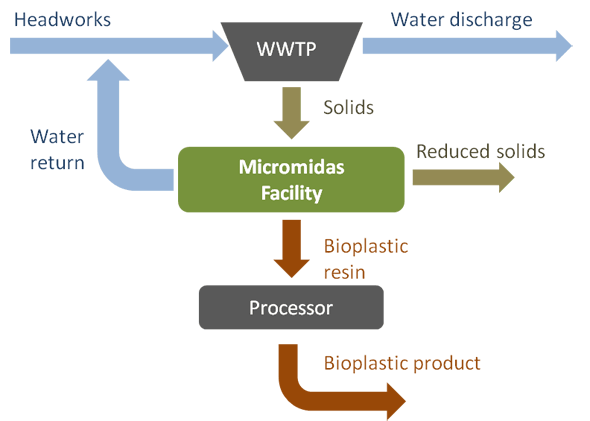
Micromidas is using carefully constructed populations of bacteria to convert organic waste into
bio-degradable plastics.
The Feedstock
The economics of the industrial chemicals and materials industry are driven, for a given product, by feedstock, processing costs, and market price. Within each of these primary drivers there exists a subset of levers which can be used to manipulate the economics of the system. The proposition of the renewable movement has been that a shift in feedstock coupled with alternative conversion and processing will produce a substitute product with the additive effect of reducing the expenditure of finite resources.
The choice of feedstock is constrained by conversion technology. Consequently, preference of feedstock has necessarily been balanced against the performance risk of unproven conversion technologies. To hedge against risk associated with the development of the feedstock infrastructure and pre-processing, feedstock choice has been largely confluent across conversion platforms. This has amplified inefficiencies in feedstock choice, such as seasonality, logistics, and capacity ramp, and made them endemic to the renewable movement.
Micromidas’ goal is to decouple biological products from their feedstock by applying a carefully constructed microbial population that is capable of consuming a variety of materials—including waste.
The Plastic
Micromidas’ initial commercialization effort is the production of polyhydroxyalkanoates— bio-degradable, renewably-derived plastics.
The Process